Handlers in TypeScript or Python
A project's behaviour can live in .py or .ts files beside the model, where
your editor's tooling helps. archec binds each function to its place in the
model by name. It copies the code into the Arche project, and brings back code
you edit in the Arche app. This page is about those files; the contract with
Arche is handlers.md.
A first code file#
Save this as main.arche. The counter's fn main has no body in the model: it
takes the def main of counter.py.
project "Counter" {
  handlers python
}

message TICK { n: int32 }

component Counter "Counter" {
  code "counter.py"
  out tx: data sends TICK
  var n:  int32 = 0
  fn main
}

component Display "Display" {
  in rx: data receives TICK
}

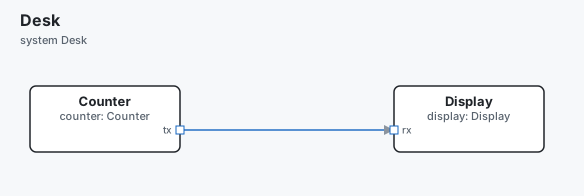
system Desk {
  part counter: Counter
  part display: Display
  counter.tx -> display.rx
}
And this as counter.py, beside it:
from arche import *

async def main(self):
    while True:
        await wait(ms(10))
        self.n += 1
        send(self.tx, TICK(n=self.n))
Run it:
$ archec sim main.arche --for 30ms
Counter — system Desk, 30.000 ms simulated
   10.000 ms  counter.tx → display.rx  TICK {"n":1}
   20.000 ms  counter.tx → display.rx  TICK {"n":2}
   30.000 ms  counter.tx → display.rx  TICK {"n":3}

3 message(s), 0 state change(s)
archec stubs main.arche writes a typed arche package, so your editor knows
the names from arche import * brings in. It writes the package in
.arche/typings, not beside your code:
$ archec stubs main.arche
✓ .arche/typings/arche/__init__.pyi
✓ .arche/typings/arche/_model.pyi
  pyright: extraPaths = [".arche/typings"] under [tool.pyright] in pyproject.toml · mypy: mypy_path = ".arche/typings"
__init__.pyi holds Arche's helpers, and is the same for every model.
_model.pyi holds this model's messages and constants. The VS Code extension
writes the same files on its own, and Pylance finds them with no setting (see
editor.md).
On the command line, tell the checker where the package is. In
pyproject.toml:
[tool.pyright]
extraPaths = [".arche/typings"]

[tool.mypy]
mypy_path = ".arche/typings"
Use pyright's extraPaths, not stubPath: with stubPath pyright finds the
names but warns that the module has no source.
- A main file with another name has its own folder:
archec stubs bench.archewrites.arche/typings/bench/arche/, and prints the path to use. --out <dir>writes the package in the folder you name.--besidewrites onearche.pybeside the.pyfiles, as earlier versions did.- The folder has its own
.gitignore: git ignores it, and it is written again from the model.
The handler language#
A project says the language its behaviour is written in:
project { handlers typescript }. This is whatarchec newwrites.python.arche: the action language, which archec translates.
TypeScript bodies get self. When a message triggered them, they also get
msg, an object { name, …fields }. The API is Arche's: await wait(ms(10)),
send(self.out, MSG({ f: 1 })), await goto("Run").
archec reads TypeScript without TypeScript installed. It runs it in
archec sim, writes .arche/typings/arche.d.ts for the editor (archec stubs), and tells
Arche the language in simulation.yaml. For an example, see
examples/ts-handlers.
Some TypeScript is portable: it keeps to what the action language says. That is
assignments, if, while, counted for, send, goto, wait, log,
Math, the part's functions and msg.field. archec gen --target c|embassy|go
translates portable TypeScript as it translates ```arche, and
archec difftest compares it with its C. For anything else, archec check
names the construct (ts-portable), and the generated code has a TODO
(handlers.md).
To move a model to another language, run
archec convert-handlers main.arche --to typescript (or python, arche). It
rewrites the model's blocks, code files and guards in place.
- From
```arche, the result is exact. - From Python and TypeScript, it goes statement by statement.
- What does not translate is kept as a
TODO(convert)comment.archec checkkeeps reporting it until you rewrite it.
Code in .py and .ts files#
This section is about Python bodies kept in .py files beside the model. The
next one is about the way back from the Arche app and the simulator.
A body that the action language can say reads better as a ```arche
block: see concepts. Longer code
reads better in a .ts or .py file, with your editor's tooling. A .ts file
binds the same way; its functions look like
export function main(self: Ctrl) { … }.
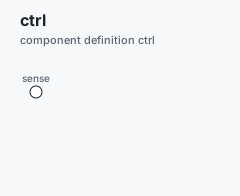
component ctrl {
  code "ctrl.py"
  fn main                                  // ← def main(self) in ctrl.py
  in sense: i2c receives SAMPLE { on-receive on_sense }
  states { state Off; state On { on-enter enter_on } }   // on-exit: def on_exit_On, by its name
}
How a def binds to the model:
- A
fnwith no block takes the def of the same name. - Every code property takes the def it names:
on-enter,on-exit,on-receive,on-write,body, and a transition's/ action. - Some names bind with nothing written:
on_enter_<State>,on_exit_<State>,on_receive_<port>andon_write_<MEMORY>. codeon the project or on a system is a shared file. Its defs bind only when they are named.- A def's parameters are
selfand the fn's arguments. For a hook, they are the names Arche gives that hook:msg,rise,from_,writer, and so on. - A def with no
selfis a plain function, as a library's.pyhas them. It binds to a fn whose parameters have the same names, in the same order:def gcd(a, b)binds tofn gcd(a: int64, b: int64) -> int64. A barefn gcd, which says no parameters, takes the def's. - A def's docstring becomes the element's description.
Arche keeps Python inside its project files. So archec copies each body in. The Arche project is the same as the one you would get with the same code written inline.
archec fmt --extract-code --writemoves existing blocks out to files: one file per component, or one file with--extract-code=behaviour.py. It is tested to change nothing in the result.- The imports, constants and helper functions at the top of the file are copied into the bodies that use them.
- Each body gets its own copy. So a top-level name cannot keep state between
calls, and a function that changes one is an error. Keep state on the
component instead (
var n,self.n). from arche import *is for the editor only.archec stubswrites a typedarchepackage in.arche/typings, with Arche's helpers and the model's messages and constants. The VS Code extension writes it on its own. Then Pylance or pyright complete and check the code.
Python that the action language cannot say#
Some Python has no translation: a list that grows, a dict, an int past 64 bits, numpy. Such a body still runs in simulation:
archec simruns it in a realpython3, and the page in Pyodide (sim.md). Acode "x.py"file is loaded as a module, so its imports, helpers and classes are there.- Arche's simulator runs it, as it runs all Python.
archec sim main.arche --doctestruns the file's doctests.
Two properties say what such code needs:
component Primes {
  simulation-only                 // it runs in simulation and on a host, not on a microcontroller
  pip "sympy>=1.12"               // what its Python imports; archec sim prints the pip command when missing
  code "primes.py"
  fn primes_below(n: int64) -> any
}
simulation-only: the C, C++, Rust (Embassy) and Go generators refuse a deployment that puts it on a microcontroller, and say why. A process on Linux keeps it. (sim.md)pip: the packages, as pip takes them.pip "python>=3.14"asks for a Python version:archec simthen looks forpython3.14on the PATH.
A value that is a list, a dict or an object is typed any in the model (or
T[], or a struct with the dict's keys). sim.md says how
each value crosses.
The way back: code edited in Arche, and simulator errors#
Every build writes .archec/sourcemap.json into the project. It records where
each piece of code comes from, and the text it had.
Code edited in the Arche app goes back to its source#
archec pull main.arche --write compares three things:
- what the last build wrote;
- what the Arche project holds now;
- what your sources give now.
Code changed only in Arche is written back where it came from: into the def of
the .py file, or into the ``` block of the .arche file. A def becomes
async def if the new body awaits.
- Code changed on both sides is a conflict. It is left for you to merge.
- A change to the top-level code copied into a body is left for you too. Edit
that in the
.pyfile. - A build refuses to overwrite code that was edited in Arche and not pulled.
--forcedrops that code. - In VS Code, saving in Arche offers the pull. The setting
arche.pullOnChangeisask,alwaysornever. The pull is applied as one edit you can undo. Arche: Pull Code Changes does it by hand.
Only code comes back. Positions, names and other edits made in the app are still overwritten by the next build.
Simulator errors point at your lines#
Arche reports an error on a line of its copy, for example
ZeroDivisionError (Controller › Control loop, line 4).
archec testandarchec runbuild, run arche-cli, and add the source line:(Controller › Control loop, line 4 → ctrl.py:32).archec where main.arche "<error>"does it for any text. So doesarche-cli test out | archec where main.arche -.- In VS Code, Arche: Run Tests puts each error on its line in the Problems view. Arche: Go to Simulator Error… takes an error pasted from the Arche app.
- A state's on-enter and on-exit share one label in Arche's messages. So both lines are offered.
Limits#
These limits are described above; here they are in one place.
Python that the action language cannot say is not translated:
archec genwrites a TODO for it on a host, and refuses it on a microcontroller when the component sayssimulation-only. It runs in simulation only.convert-handlerstranslates Python and TypeScript statement by statement. What it cannot translate stays as aTODO(convert)comment for you to rewrite.A top-level name in a
.pyfile cannot keep state between calls: each body gets its own copy. Keep state on the component.A change to top-level code that was copied into a body is not pulled back from Arche. Edit it in the
.pyfile.Only code comes back from the Arche app. Positions, names and other edits made there are overwritten by the next build.
A state's on-enter and on-exit share one label in Arche's messages, so an error there points at both lines.