Handlers: TypeScript, Python, the action language
A handler is a piece of a model's behaviour written as code: a function's body,
a port's on-receive, a state's on-enter. You write it in TypeScript, in
Python, or in the action language (```arche), which archec translates.
TypeScript is what archec new writes.
A first handler#
Save this as main.arche. The project says its handlers are TypeScript. The
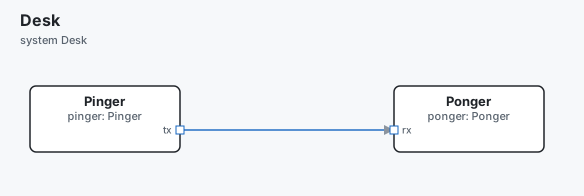
pinger sends a numbered PING every 20 ms, and the ponger logs the ones after
the first.
project "Ping" {
  handlers typescript
}

message PING { n: int32 }

component Pinger "Pinger" {
  out tx:   data sends PING
  var sent: int32 = 0
  states {
    state Idle
    state Busy {
      on-enter ```ts
        self.sent += 1
        send(self.tx, PING({ n: self.sent }))
      ```
    }
    Idle -> Busy on "after 10ms"
    Busy -> Idle on "after 10ms"
  }
}

component Ponger "Ponger" {
  in rx: data receives PING {
    on-receive ```ts
      if (msg.n > 1) log("got", msg.n)
    ```
  }
}

system Desk {
  part pinger: Pinger
  part ponger: Ponger
  pinger.tx -> ponger.rx
}
Run it in the browser simulator:
$ archec sim main.arche --for 30ms
Ping — system Desk, 30.000 ms simulated
    0.000 ms  pinger: Idle
   10.000 ms  pinger: Idle → Busy
   10.000 ms  pinger.tx → ponger.rx  PING {"n":1}
   20.000 ms  pinger: Busy → Idle
   30.000 ms  pinger: Idle → Busy
   30.000 ms  pinger.tx → ponger.rx  PING {"n":2}
   30.000 ms  ponger: got 2

2 message(s), 4 state change(s)
at 30.000 ms: pinger Busy
To have the same handlers in Python, convert them:
$ archec convert-handlers main.arche --to python
2 bodies, 3 statements translated, 0 left as TODO(convert)
✓ main.arche
The project now says handlers python, and the ponger's body reads:
if n > 1:
    log("got", n)
The rest of this page is the contract between archec and Arche's simulator.
Both sides do what it says. For anything it does not say, do what the Python
runtime does (Arche's arche_runtime.py), with the same names.
1. Which language a piece of code is in#
In arche-lang, the language is chosen at four levels:
- The project says it:
project { handlers typescript }, orpython, orarche. - A component may say its own:
component Legacy { handlers python }. Without one, a component takes, in this order:- its definition's language;
- the language of the component around it;
- the language of its
codefiles (code "ctrl.ts"is TypeScript,code "ctrl.py"is Python); - the project's language.
- A block says its own:
```ts,```python,```arche. A bare```block is in the component's language. - A project without
handlerskeeps the language its code is in. Python somewhere (a.pyfile, a```pythonblock or a bare block) makes itpython. Otherwise it istypescript.
archec new writes handlers typescript. Use
archec new --handlers python|arche for the others.
In the Arche project:
simulation.yamlsays the project's language:behavioral: { language: typescript | python }. When it is absent, the language ispython, so every existing project keeps working. archec writes it when the project sayshandlers, or when the project has code and that code is TypeScript.- A model file's code file decides the language of that file's code:
code: "rfic.ts"is TypeScript,code: "rfic.py"is Python. - Inline code follows the component's code file when it has one, else the project's language. Inline code is activation bodies, handlers, state actions, and guards written as code.
The action language is translated:
- for Arche, to the project's language. That is TypeScript, or Python in a
handlers pythonproject.handlers archegives TypeScript. - for firmware, to C, Rust or Go, as before.
A call to another part is translated too. For example, brake.apply(2.5) goes
through a port that requires an interface with that operation. It becomes what
a handler writes for it: await component("brk").apply(2.5), for the part at
the other end of the link (the specification).
archec copies every body into the Arche project, so Arche runs one language for
the whole project. A code "x.ts" function becomes the inline body it would be
written as. A block in the other language is reported (handlers-language):
archec sim runs it, but Arche would not.
2. What TypeScript code looks like#
The source is TypeScript. Both sides remove the types and run the JavaScript. archec removes them itself (src/tscode.ts), so there is nothing to install. Arche uses a small transpiler in the page. Nothing is type-checked before it runs.
A code file mirrors a .py file one to one, with the same function names:
import { send, reply, goto, wait, ms, warn, u8 } from "arche"   // optional: the names are global anyway
import type { Rfic, SPI_FRAME } from "arche"                     // archec stubs: the model's types

export async function rfic_on_receive_spi(self: Rfic, msg: Rfic.Msg) {
  if (msg.name !== "SPI_FRAME" || (msg.cs !== self.cs_index && msg.cs !== RFIC_BROADCAST)) return
  self.frames += 1
  if (msg.cmd === 0) reply(SPI_FRAME({ cs: msg.cs, cmd: 0, addr: msg.addr, data: await self.readRegister(msg.addr) }))
  else await self.writeRegister(msg.addr, msg.data)
}self. The first parameter isself, as in Python.self.xreads and writes a variable.self.STATUS.stateis a port's state.self.mem[...]is memory.await self.f(a)calls a function of the component.- Only the owner writes its variables. This is the same rule as in Python.
- A received message is a value, not bare names.
- Python puts a message's fields in scope as bare names, and passes its name
as
message. - TypeScript passes one argument,
msg. It is an object with the fields by name and the message'sname:{ name: "SPI_FRAME", cs, cmd, addr, data }. - In inline code,
msgis in scope.messageis in scope too, as the message's name (a string), for code moved from Python.
- Python puts a message's fields in scope as bare names, and passes its name
as
- Inline code is the body of an
asyncfunction.selfis in scope, andmsgtoo when a message triggered it:self.count += 1; await goto("Run"). - Message constructors take one object:
SPI_FRAME({ cs: 1, cmd: 0 }). This replaces Python's keyword arguments. - Enum literals and constants are global names, as in Python.
In a model, a code "ctrl.ts" file binds to the model as a .py file does.
Each element takes the function with its conventional name:
| Element | Function in the file |
|---|---|
fn main |
main |
a state On |
on_enter_On and on_exit_On |
a port rx |
on_receive_rx |
a memory M |
on_write_M |
on-enter name |
the function named |
A function's parameters are self and the fn's arguments. For a message's hook
they are self, msg. Other parameters are reported (py-params).
The constants, types and helper functions at the top of the file are copied
into each body that uses them. Imports are only for the editor, and are
dropped. Only "arche" and "./arche" may be imported: both name the model's
arche.d.ts.
3. The API#
The API is a set of global names. They are the same as in arche_runtime.py.
Waits are awaited, as in Python:
wait(d), wait_until(test, timeout?), clock(n?), recv(port, timeout?),
select(...ports) / select([ports], timeout),
call(port, msg, to?, timeout?), goto(state), put/get/take(port, …),
lock(port, timeout?), wait_bits(port, bits, { all, clear, timeout }),
stream_write/stream_read, compute(d).
Immediate calls are not awaited:
- messages and ports:
send(port, msg, to?),reply(msg),give,unlock,set_bits,clear_bits,queued,start_timer,stop_timer,pulse(signal, width?),at(address),message(name),component(name); - output:
log(...a),warn(...a),print(...a)(to the trace),fail(msg?); - time and chance:
now(),rand(),randint(lo, hi),randn(mu?, sigma?). The engine seeds them. Never useMath.randomorDate; - durations:
ns/us/ms/sec(x),to_ms/to_us/to_s(t),fmt(t); - bits and integers:
bits(v, hi, lo?),bit(v, n),setbits(v, hi, lo, x),u8/u16/u32/u64/i8/i16/i32/i64(n).
Python's with locked(p): is await lock(p); try { … } finally { unlock(p) }.
Math.* is allowed, except Math.random.
The rules are the same as in Python:
- Determinism. Stepping back runs the code again, and it must give the same result.
- Runaway loops. Loop turns are counted. Past the same limit, it is an error.
4. Where it runs, and types#
Arche runs it in a
JsRuntime(Lang = 'python' | 'typescript') in a Web Worker, with no DOM and no network. The engine owns time and state. It uses the same host-call protocol as the Python bridge. Pyodide is loaded only when the project has Python code.archec sim(src/websim.ts, src/websimrt.ts) runs the JavaScript directly, with the same API. It runs in node, in the pagearchec sim --htmlwrites, in the live page, and in VS Code's ▶ panel.archec stubswritesarche.d.tsin.arche/typings, in the folder of the main file. It writes Python'sarchepackage in the same place. The file holds:- the API's signatures;
- an interface per message, with
name; - a type per component: its variables, ports and functions, its states as a
string union, and a
Msgunion of what it receives; - the constants and the enums.
Nothing is written beside the code, and there is no
tsconfig.json. In VS Code, the extension writes the file on its own, and its TypeScript plugin makes"arche"and the global names resolve to it (see editor.md). Fortscon the command line, add two lines to yourtsconfig.json;archec stubsprints them:{ "compilerOptions": { "paths": { "arche": ["./.arche/typings/arche.d.ts"] } }, "include": ["*.ts", ".arche/typings/arche.d.ts"] }A
pathsentry maps"arche", not"./arche": import from"arche"in files thattscchecks.archec stubs --besidewritesarche.d.tsand atsconfig.jsonbeside the.tsfiles instead, as earlier versions did.
5. Test plans and guards#
Arche runs a test plan's code in the project's language. That code is a step's
do and expect, a setup, or a stimulus. In arche-lang you write it in
Python, as before. In a TypeScript project, archec writes it to Arche as
TypeScript (src/testcode.ts):
| Written | Arche runs |
|---|---|
abs(c.x) < 0.1 and not c.done |
Math.abs(c.x) < 0.1 && !(c.done) |
send(rx.frames, RC_FRAME(throttle=1200, arm=True)) |
send(rx.frames, RC_FRAME({ throttle: 1200, arm: true })) |
x is None, min, max, round, int, len(xs) |
x === null, Math.min, Math.max, Math.round, Math.trunc, (xs).length |
pass, # note |
nothing, // note |
if c: / elif / else: / while c: / for i in range(n): / for x in xs: |
the same in braces |
- The prefix of an expectation (
within 5ms:,never:,always:) stays as it is. - What already reads as TypeScript (
a && b,GO({ n: 1 })) is left as it is. A```tsblock is written as it is. - Some Python has no simple TypeScript:
a if c else b,in,//, adef,with,try, an f-string, a lambda. It is reported (test-typescript). Write it another way, or in a```tsblock.
A transition's guard and action are written the same way in a TypeScript
project. [abs(angle) > FALLEN] reaches Arche as Math.abs(angle) > FALLEN.
The trigger's fields are in scope by name, in either language.
In archec#
| What | How |
|---|---|
| Write the language | project { handlers typescript }, component c { handlers python } |
| Move blocks to a file | archec fmt --extract-code=behaviour.ts --write main.arche (or --extract-code alone: one file per component, in its language) |
| The editor's types | archec stubs main.arche → .arche/typings/arche.d.ts (and the arche package when there is Python) |
| Run it | archec sim main.arche (--html, --plant, --batch, --test), archec difftest |
| Check it | archec check: each TypeScript syntax error on its line (ts) |
| Change the language | archec convert-handlers main.arche --to typescript|python|arche [--component C] [--dry-run] |
Limits#
What archec sim runs of the API:
- the waits
wait,compute,goto, and the part's own functions; send,reply(on the port the message came in by),log,print,warn,fail,now;- the seeded
rand,randint,randn; - the durations,
fmt, the bit helpers, the integer casts,message(name).
What it does not run:
recv,select,call,put/get/take,lock, the bits, streams and timers,wait_until,clock,pulse,at,component. Each one stops the body with an error that says Arche's simulator runs it.Math.randomandDate. They are errors too, because a run must replay.- A port handle's
state. It does not exist inarchec sim.
TypeScript that does not read:
- an
enumor anamespace. They have no JavaScript of their own. Use a union of strings, or the model's enum. - a constructor's
public xparameter. - an
asyncarrow function, in archec sim. Write anasync functioninstead.
A message with no fields, such as message GO: bool, is { name, value }.
Portable TypeScript#
The simulators run any TypeScript. The generators do not.
archec gen --target c|embassy|go and archec difftest translate only what the
action language can say, as they do for ```arche. A TypeScript body
that keeps to this subset is read into the action language's tree. Then the C,
Rust or Go is written from that tree.
The subset:
| TypeScript | The action language |
|---|---|
let x = e, const x = e (a value given) |
var x = e |
self.x = e, +=, -=, *=, /=, self.n++, --k |
x = e, n += 1, k -= 1 |
if (c) … else if (c) … else …, while (c) { } |
if, while |
for (let i = a; i < b; i++) (or i <= b, i += 1) |
for i in a..b |
send(self.p, MSG({ k: v })), MSG(), { k } |
send p MSG { k: v } |
await goto("Run"), await wait(ms(2)), wait(ms(self.t)) |
goto Run, wait 2ms, wait t * 1ms |
log(…), print(…) |
log … |
await self.f(a) |
f(a), the part's function |
msg.distance, msg.name |
distance, message (the received message's fields) |
self.state === "Idle" |
state == Idle |
=== !== < <= > >= + - * / % && || !, x ** 2 |
== != … and or not, x * x |
Math.abs min max sqrt sin cos atan2, Math.trunc(x), Number(x), Math.PI |
abs …, int(x), float(x), a literal |
now(), to_s(t), to_ms(t), ns/us/ms/sec(x) |
the same |
return, break, continue, numbers, strings, true, false, constants, Color.Red |
the same |
Then the action language's check runs. The body stays out of the subset if it has a name the check does not know, a type that does not fit, or a division of two integers. (TypeScript divides integers as floats.)
These are outside the subset: an array or an index (the action language has
them, buf[i]; TypeScript's are not read into it), a ternary, a template
string, a method of a value (list.push), a helper function, reply, recv, a
bit operator, switch, try. Such a body still runs in the simulators as it
is. The generators write a TODO with the TypeScript in its place, as they do for
Python they cannot translate. archec check names the construct (ts-portable).
It is info in a project that only simulates, and a warning when a deployment
generates code for the component.
A port's on-receive in TypeScript may read its message (msg.distance). In C
it gets the message as <part>_on_receive_<port>(self, const void *arche_msg),
with its fields by name. A transition's guards and actions get theirs the same
way. A guard written in TypeScript ([msg.force > 0]) is translated the same
way too. So archec difftest compares the TypeScript the simulator runs with
the C it becomes. examples/ts-handlers agrees.
Converting#
archec convert-handlers main.arche --to typescript|python|arche rewrites the
model's handlers in another language, in place. It rewrites:
- each ``` block, keeping its fence and indentation;
- each
codefile.code "ctrl.py"becomes"ctrl.ts". The old file is kept; remove it when you are done. Toarche, each function becomes a```archeblock on its element; - the transitions' guards;
handlerson the project, or on the component with--component Ctrl.
How each language is read:
- From
```arche: exact, by the same translators that make Arche's copy. - From Python: statement by statement, through what the action language says. This is the same reading the generators use for Python.
- From TypeScript: statement by statement, through the portable subset above.
- A received message: Python's bare field names (
distance) become TypeScript'smsg.distance, and Python'smessagebecomesmsg.name. The action language has no message in a body, so a statement that reads one stays a TODO.
What happens to the rest:
- A statement that does not translate stays as a comment with the original:
// TODO(convert): <python>, or# TODO(convert): <ts>in Python. The command lists each one with the reason.archec checkreports it (convert-todo) until you write it. - Comments between statements are kept. A comment at the end of a line, or inside a nested block, is not.
- Nothing is written when the result has more errors than the model.
--dry-runonly says what would change.
Converting keeps the meaning, not the text. clamp(x, a, b) comes back from
TypeScript as min(max(x, a), b), and a - b + (c - d) as a - b + c - d.
Diagnostics#
| Code | |
|---|---|
handlers |
handlers names no handler language |
handlers-language |
code in another language than the one Arche runs the project in |
code-language |
a ``` block of a language that is not a handler language |
ts |
TypeScript that does not read, has no JavaScript, imports a module, or keeps state at the top of a file |
ts-portable |
a TypeScript body outside the portable subset: the construct; the generators write a TODO |
convert-todo |
a statement archec convert-handlers left as a TODO(convert): comment |
py-params, py-not-found, py-unused, code-not-found |
as for .py files |
test-typescript |
test code in a TypeScript project that archec cannot write as TypeScript (§5) |